Translation of La
enigmática cena de Einstein en Barcelona by Carmen
Morán published in El País of 11-08-2005
The discoverer of the theory of
relativity visited the Catalan capital in 1923. A group of scientists
organized a soirée during which there was a tasting of dishes
with mysterious names. Catalan physicists are deciphering that menu
so that they can organize a similar dinner this autumn.
On 27 February 1927, Einstein attended a
dinner which was held in his honor by scientists, politicians and
diplomats in Barcelona. It was a substantial meal with ample liquid
refreshment for a frugal genius who was traveling from one conference
to another in Spain. In his diary, Einstein recorded the friendship
and warmth that he enjoyed on that trip in which there was also
complicity, good humor and a touch of mystery. What did they have for
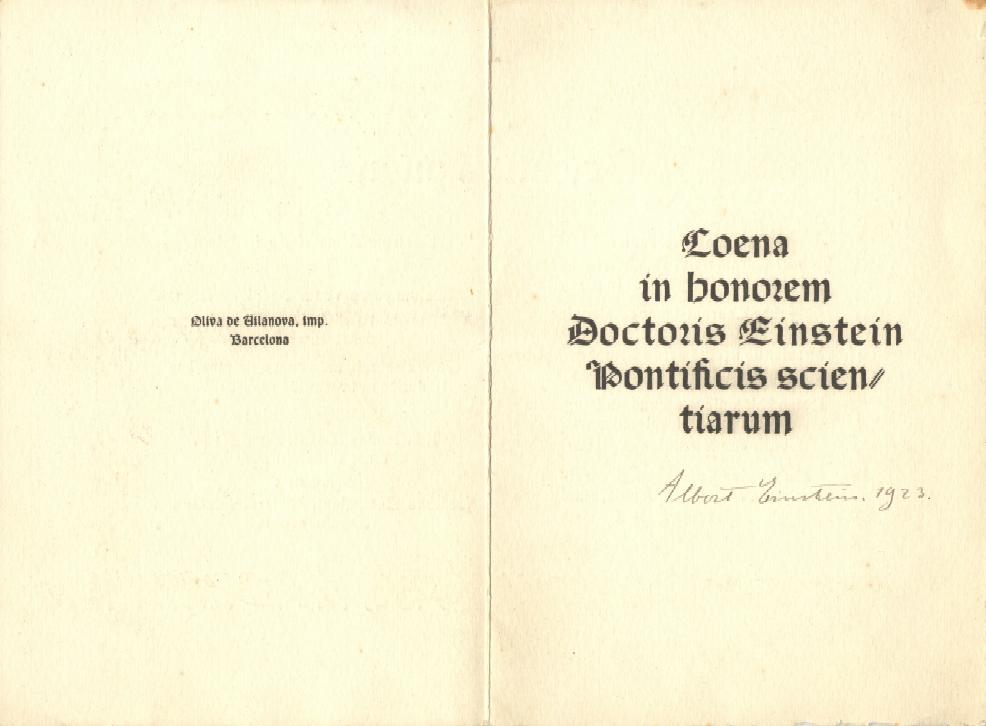
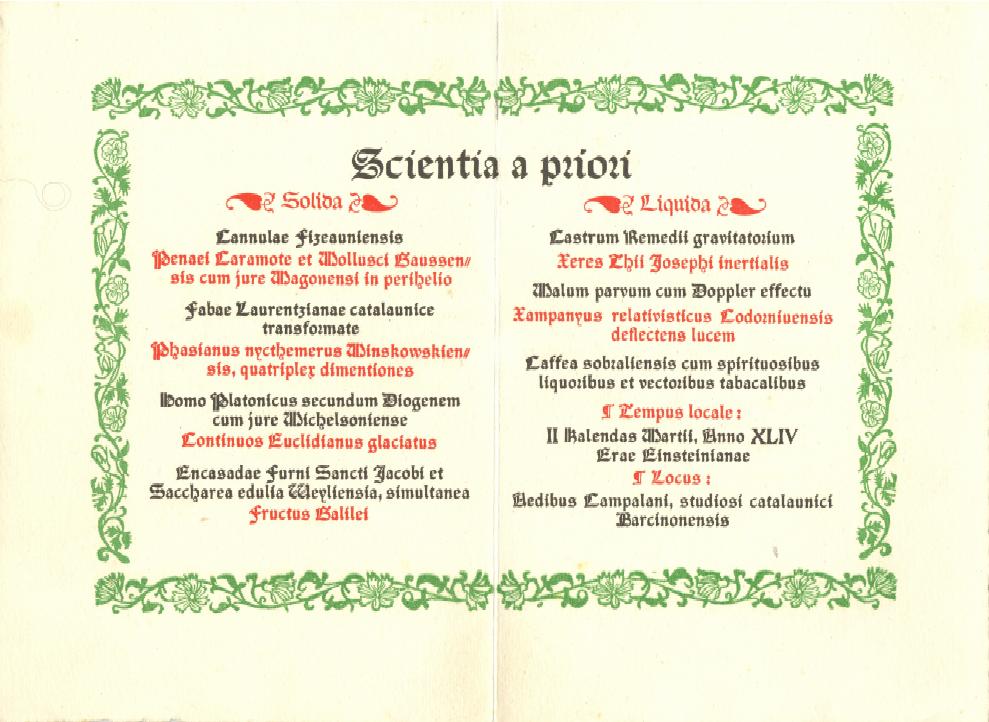
dinner that night? The menu, written in relativistic Latin and
printed in Gothic script, as it was described in the newspapers of
the day, contained an enigma in each entry: Homo platonicus
secundum Diogenem cum jure Michelsoniense, Malum parvum cum
Doppler effectu, Fructus Galilei, Caffea sobraliensis
cum spirituosibus liquoribus et vectoribus tabacalibus. It was
nothing more than a friendly joke perpetrated by the Catalan
scientists who met him on that visit. But what did it all mean?
Two Catalan
physicists, Emma Sallent and Antoni Roca, have been deciphering the
clues. Firstly, they translated the Latin: Homo platonicus
secundum Diogenem cum jure Michelsoniense. They ate chicken!
Plato defined 'man' (homo) as a biped without feathers. The cynic
Diogenes sent him a plucked chicken as a joke. The Michelson sauce is
in honor of the German physicist.
Roca
had a Eureka moment when he tried to uncover what was behind
the caffea sobraliensis. Sobral was the Brazilian village
where the British expedition went to observe the solar eclipse of
1919 to check the predictions of Einstein's general theory of
relativity. After good Brazilian coffee there were vectorial
brandies and liquors. Perhaps the friends of the famous professor
mixed the bandy and the coffee so that he could try the well known
carajillo (coffee with a dash of brandy).
By decoding the menu, more of which
later in this article, the Catalan physicists want to reproduce that
famous dinner this year. A number of them, together with
representatives of Catalan societies of physics and the history of
science and technology, are organizing it for this autumn. “We
are trying to commemorate and promote physics and spread the legacy
of Einstein”, explained Professor Luis Navarro. A catering
college may well be responsible for the menu which will be served to
the significant number of diners.
Einstein came to Barcelona five days
before that dinner, on Thursday 22nd February of 1923. Nobody went to
meet him at the station so he picked up his things and went to the
house of the scientist Esteve Terradas, who was not at home. He left
a note, asking him the name of the hotel where he was staying. Then
he went in search of the engineers, Casimir Lana Sarrate and Rafael
Campalans, the second of which was the head of the Consejería
de Pedagogía de la Mancomunidad de Cataluña (the
Ministry of Teaching for the community of Catalonia), the institution
that had invited the Nobel prize winner to Barcelona. It was
Campalans who promised to pay Einstein 3000 pesetas for his
conferences. Einstein actually received 3500 pesetas.
Campalans was also
the host at the dinner, and his mother was the cook of many of the
dishes that they tasted. The press of the time reported on the
banquet, the diners and especially the music: “Regino Sainz de
la Maza played the most beautiful guitar pieces; the Trio Barcelona
interpreted chosen items from its best repertoire; the famous soprano
Andrea Fornells sang a selection of songs of her homeland... ”,
wrote the periodical La Veu de Catalunya (the Voice of
Catalonia) the next day. It concluded, “The eminent professor
was very pleased, especially admiring and taking a lively interest in
the Catalan songs”.
Among the guests were the German consul,
Ulrich von Hassel, and his wife, Ilse von Tirpiz, senior civil
servants of the Barcelona town hall and the colleagues who organized
the trip and the meal, Lassaleta and Lana Serrate. The latter
certainly attended as the press mentioned his name. Of the others we
are not sure. For example, there is doubt about the attendance of
Professor Terradas whose family circumstances were complicated at
that time owing to the death of his small daughter. For this reason,
the investigators Sallent and Roca who wrote the article about
Einstein's dinner in the Revista de Física (Physics
Journal) did not think that he collaborated in the writing of the
enigmatic menu.
Each dish (eight
“solid”) on the menu
included a reference to scientists or philosophers and to scientific
theories related to the illustrious guest: Habas a la Lorentz
transformadas a la catalana, faisán plateado a la
Minkowski en cuatro dimensiones, helado continuo
euclídeo (beans a la Lorentz transformed a la
catalana, silver plated pheasant a la Minkowski in four
dimensions, continuous Euclidean ice cream). Among the “liquids”
were, jerez inercial, Champagne Codorniu relativista que
reflecta la luz, vinos gravitatorios y manzana pequeña
con efecto Doppler (inertial sherry, Relativistic Cordoniu
Champagne which reflects the light, gravitational wines and small
apple with a Doppler effect). An apple among the liquids? The
investigators think that it refers to cider.
In the delicious meal offered by Rafael Campalans and his wife
Conxita Permanyer there were also cannelloni. At first sight it was
thought that cannulae might be a reference to macaroni, but
Campalans' nieces Alicia and Enriqueta Marlet have no doubts in their
minds that they were cannelloni. Among the sweets, the cheesecakes
were baked in the Forn de San Jaume which Campalans knew well and
they are still baked there to this day.
The last items on the menu tell of the
time and the location of the dinner. The location was, as has already
been mentioned, at the house of Campalans at 118 Calle de Roselló.
Checking the time was a bigger head ache for the investigators
because the menu referred to the second calends of March, which must
be a mistake. “That would correspond to the 28th February and
we know that it was the 27th”, explain Sallent and Roca. And
the menu refers to the 44th year of the Einstein era. “On the
14th of March Einstein would be 44 years old, so therefore the 44th
year of his era was just finishing”.
Logically, in spite of this anecdote
about the dinner, the visit of the “first man of science”
was for something other than food. It was also marked by sightseeing
trips and political debates. He shared, with Campalans and Terrada, a
hatred for war: the three demonstrated against the first world war.
But there was something that the famous genius could not come to
terms with. How could Campalans claim to be socialist and
nationalist?: “These are incompatible”, he claimed.
Later, the engineer wrote, “he grasped the subtle and fragile
nuances of Catalan life” and reconciled “the paradox”.
“But this isn't real nationalism! Take my advice and drop that
ill-fated name”, he concluded.
On the same day as the dinner, Einstein
met some anarchist leaders causing a political incident; the press
reported that the physicist had declared himself a scientific
revolutionary, which he later denied. Biographers of the Nobel prize
winner suggest that in some of his later political statements they
could detect echoes of these conversations with his friends in
Barcelona.
Perhaps what most affected him was Catalan
music, of which he heard a wide variety. If there was a good helping
at the dinner, he was able to sample the second course the next day.
The Peña de la Danza (Dancing Club) invited him to the
Escuela Industrial de Barcelona (Industrial School of
Barcelona) to a full repertoire which he admired and took away a few
vinyls. In his diary he also kept a record of that music.
[Reproduced below is an image by screen capture of the PDF of
the menu published in the Revista
de Física which displays more quickly than the
original.]

![[Image]](../../Images/MadeWithCityDesk.gif)